Safe Cradle Recovery of an Underactuated USV:
Control System Design and Model-Scale Experimental Validation

Kiyong Park1, Jinwhan Kim1,✉, Changyu Lee2, Dong-Hoon Kim3, Woong-Ki Lee3, Ji-Wan Kim3, and Jun-Hyuk Choi3

1Dept. of Mechanical Engineering, KAIST, Daejeon  ·  2Dept. of Mechanical and Automotive Engineering, Kongju National University, Cheonan  ·  3LIGDnA, Yongin, Republic of Korea

✉ Corresponding author: Jinwhan Kim

Abstract

This paper presents a safe autonomous recovery framework that integrates disturbance observer-based model predictive control (DOB-MPC) and robust adaptive control barrier functions (RaCBFs) for docking an underactuated unmanned surface vehicle (USV) into a side-mounted cradle on a mothership. Autonomous recovery is challenging because the underactuated USV, driven by a single stern thruster and rudder, must thread a narrow cradle entrance without colliding with the mothership while rejecting persistent wind, wave, and current disturbances. To achieve robust and dynamically feasible tracking, the DOB-MPC embeds a disturbance estimate into the MPC prediction model while respecting the underactuated dynamics and actuator limits. For safe recovery, the operation is divided into an approach and dynamic-positioning phase and a docking phase, and phase-specific RaCBFs, a side-boundary barrier and a funnel-shaped docking barrier, are tightened online by the DOB error bound and embedded across the MPC prediction horizon so that safety is enforced over the entire horizon rather than one step ahead. The framework is validated through Monte Carlo simulations, where it achieves the highest recovery success rate and the fewest safety-constraint violations among the compared baseline controllers, and through pool experiments demonstrating collision-free recovery on physical hardware.

Method Overview

A two-phase recovery scenario and the safety-aware control architecture.
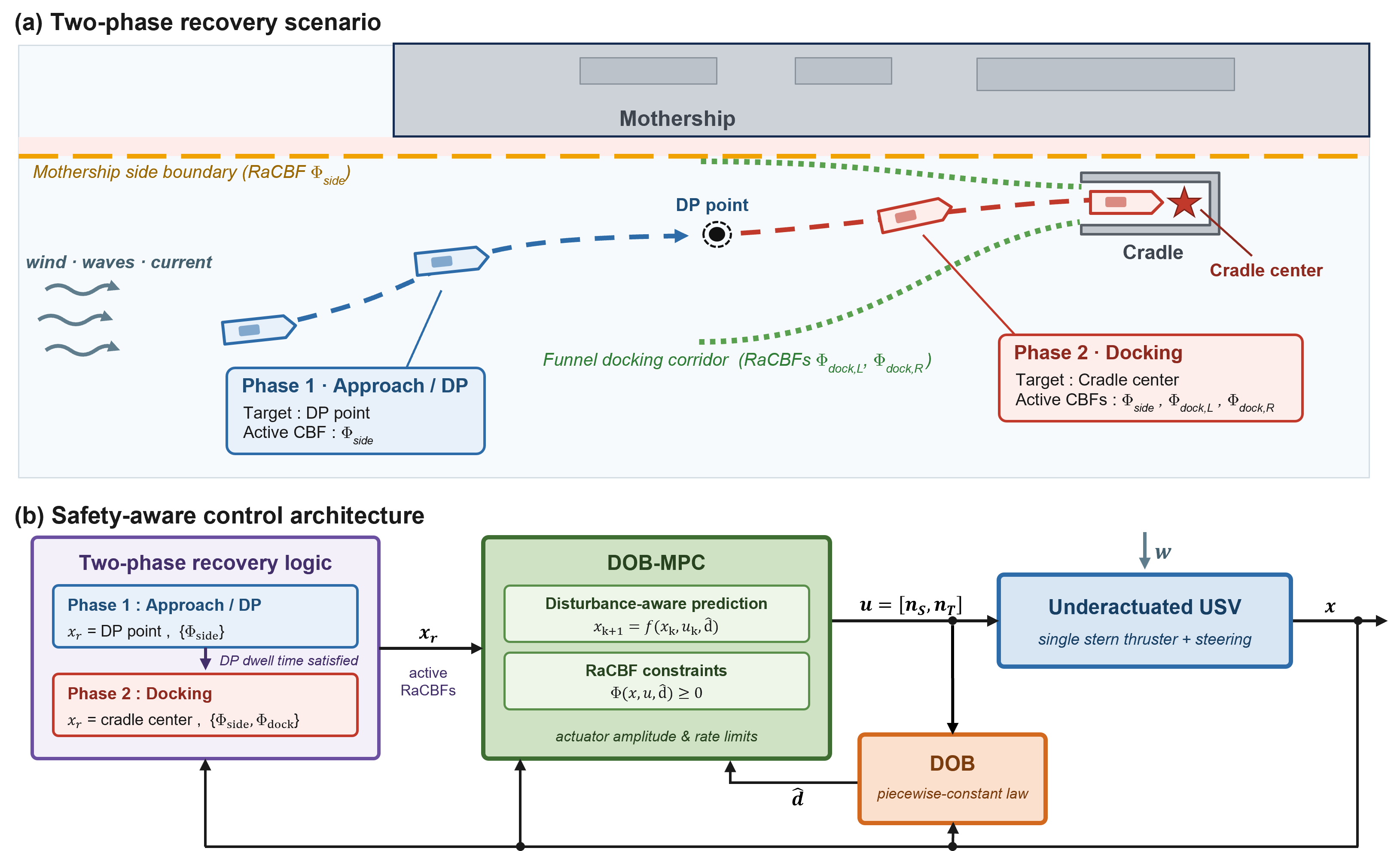
Two-phase recovery scenario and safety-aware control architecture
(a) Two-phase recovery scenario: Phase 1 approaches the mothership side and holds at the DP point under the side barrier Φside; Phase 2 enters the cradle through the funnel docking corridor under Φdock,L, Φdock,R. (b) Safety-aware control architecture: a two-phase logic switches the active RaCBFs and the MPC reference, while the DOB-MPC tracks the phase-dependent reference using a disturbance-aware prediction with RaCBF constraints.

Supplementary Videos

Animated recovery maneuvers with live safety (CBF) values.

Video 1 · Simulation recovery
Representative full recovery in simulation (cradle-fixed frame). Left: the USV threads the funnel corridor past the mothership side boundary into the cradle, with Phase 1 / Phase 2 distinguished by color. Right: the side barrier hside, funnel docking barriers hdock,L/hdock,R, and heading error evolving in real time—all barriers stay strictly positive throughout the maneuver.
Video 2 · Controller comparison
Animated companion to Fig. 10 (cradle-fixed frame): the proposed DOB-MPC-CBF against three baselines—MPC-CBF, DOB-MPC, and ALOS-CBF—on the same five Monte-Carlo trials. Runs appear one at a time, with a USV silhouette riding along each path in all four panels at once, so a given trial can be matched across controllers. Solid line with ★: success; dashed line with ×: safety violation. Run 1 is easy (all recover); Runs 2–4 each isolate one ingredient (the barrier, the tracking layer, the robust-adaptive margin); Run 5 is the hardest, where only the proposed controller threads the cradle.
Video 3 · Pool experiment
Run 1
Run 2
Run 3
Run 4
Run 5
Top: a representative real-world recovery run in the wave basin, shown with the measured trajectory (inset) and the live safety-barrier values—side and docking CBF—evolving on the right. Below: four additional recovery runs under scaled wave and current disturbances; in each, the underactuated USV (small white hull) autonomously approaches the mothership side and docks into the yellow cradle, threading the funnel entrance without contacting the mothership—the physical counterpart of the simulated maneuvers above. All clips are muted and loop independently.

Monte Carlo Results

Aggregate recovery performance and safety margins over the 100-trial study.
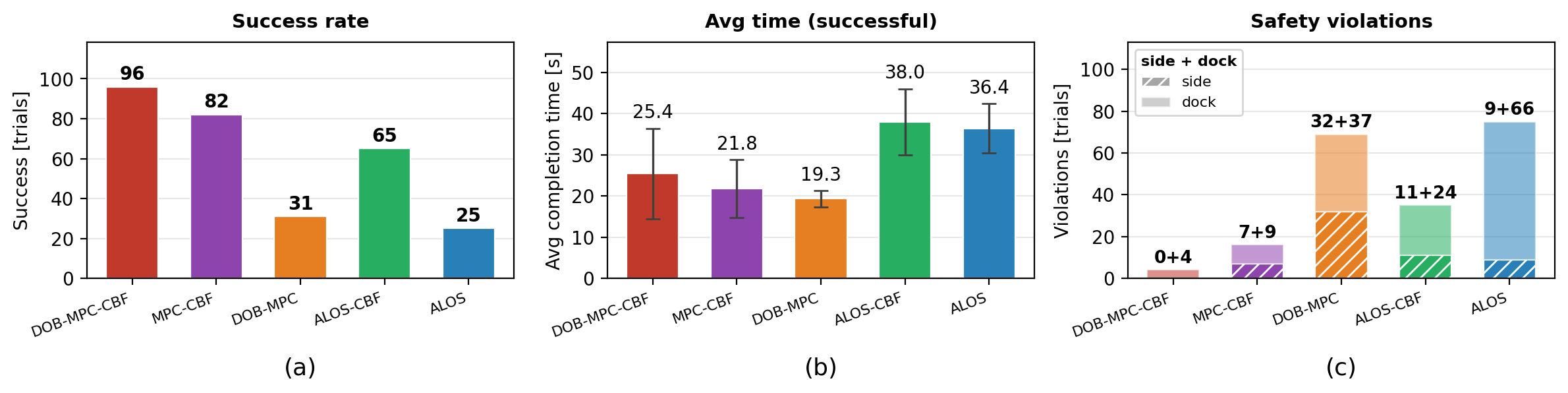
Success rate, mean completion time, and safety violations over 100 Monte Carlo trials
Monte Carlo recovery performance. (a) Number of successful recoveries, (b) mean completion time over the successful trials, and (c) safety violations split into side-boundary (hatched) and docking-corridor (solid) breaches, aggregated over 100 trials. The proposed DOB-MPC-CBF attains the highest success rate with the fewest violations.
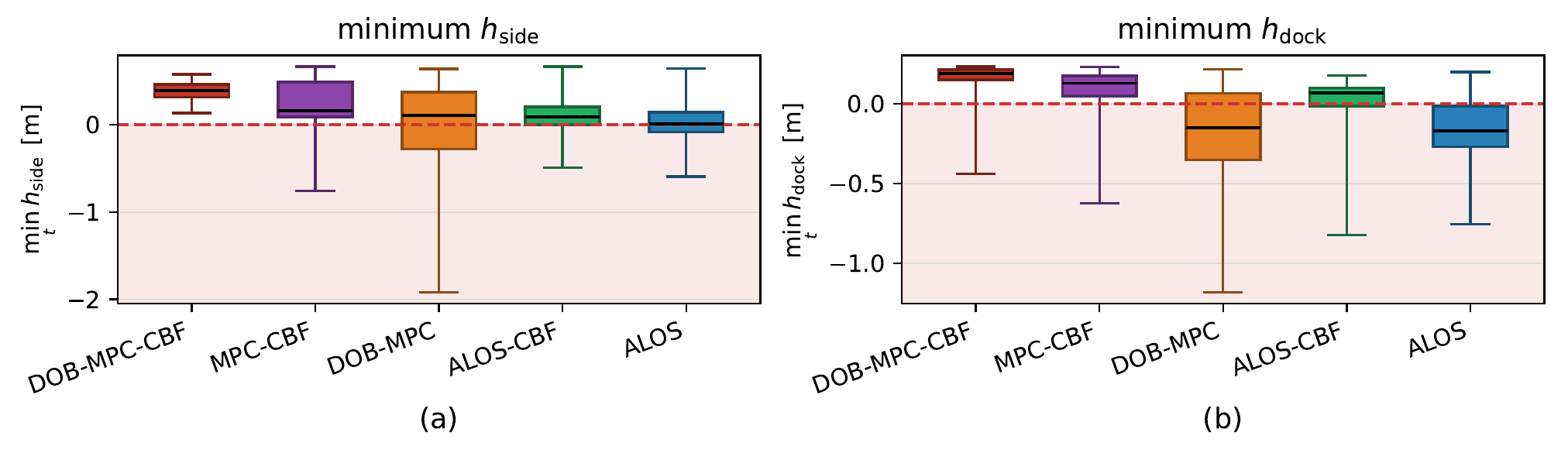
Distribution of the minimum side and docking barrier values over 100 Monte Carlo trials
Distribution of safety margins. Minimum barrier values over the 100 Monte Carlo trials: (a) side barrier hside and (b) docking barrier hdock = min(hdock,L, hdock,R). The box spans the interquartile range and the whiskers the full range across trials; values below the red line lie in the unsafe region. The proposed DOB-MPC-CBF shows the tightest distribution and the highest barrier margin among all controllers.